When Is The Best Time To Visit Penglipuran Village?
There is no bad time of year to visit the Penglipuran Village, and though the weather is a little milder and not so humid in the dry season, Penglipuran Village is welcoming and pleasant all year round.
We get an average of 8 hours a day of sunshine, even in the rainy season, so you won’t have your visit ruined by rain.
The village is open from 8.15 a.m. to 6.30 p.m. each day (for the general public, of course, the villagers may enter at any time).
The Penglipuran Village is becoming ever more popular as people hear of its charms, and if you want to beat the crowds, as with all tourist sites in Bali, it’s best to get there early in the morning.
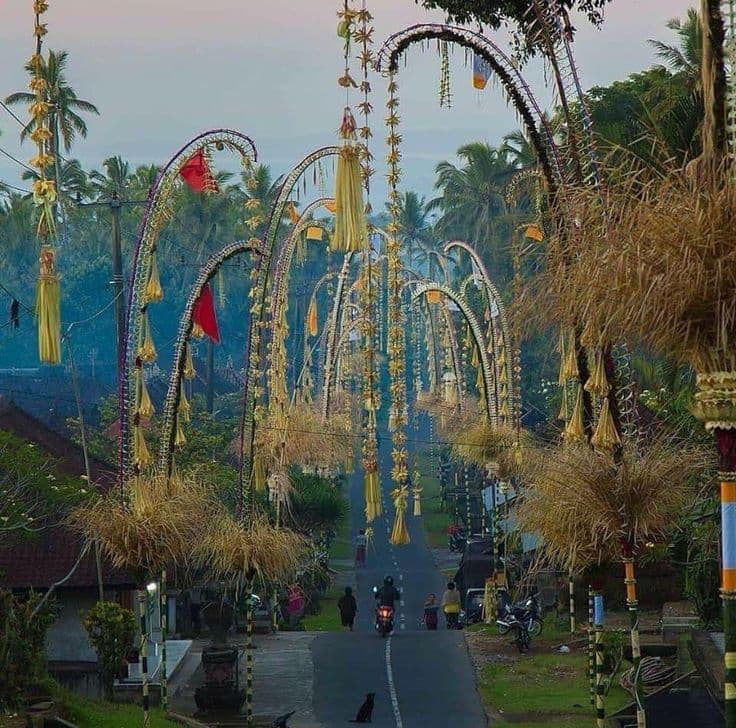
You might also try to visit Penglipuran Village during Galungan Day celebrations.
This festival takes place twice a year, and ornate penjor (a visible symbol of prosperity erected by the Balinese) is on display outside of each home in the village.
This adds some colour to an already enjoyable visit.
About The Geography Of Penglipuran Village
This village was part of the old Bangli Kingdom and is now Bangli Province in Bali.
It covers an area of over 100 hectares and sits at roughly 550 meters above sea level.
It’s just a short drive from Bangli City and a little farther from Denpasar.
Its neighbouring villages, Kayang, Kubu and Gunaska, all have very different approaches to modern life.
Because it’s elevated above sea level, the temperatures here can be as cool as 16 degrees Celsius (61 degrees Fahrenheit) to 26 degrees (79 degrees).
The History Of Penglipuran Village
There have been people in this village since the reign of I Dewa Gede Putu Tangkeban III, and nearly everyone here believes their family came from the Bayung Gede Village at that time.
This is a positive aspect as the Bayung Gede Village was famous for people who excelled at religious pursuits, Balinese traditional customs, and martial defence.
This meant their services were highly sought after, and eventually, they were offered the place where Penglipuran Village stands today as a temporary resting area.
Eventually, people began to settle in the area, and the village became permanent.
Penglupuran is derived from the words “Pengeling Pura”. “Pengeling” means “remember,” and “pura”, which can mean “temple”, also means “ancestral home”.
Thus, the village name is a reminder of the fact that the people here are migrants from Bayung Gede.
Some people argue that this interpretation is wrong and the second part of the village name comes from “lipur”, not “pura”, but this would mean “remember sadness”.
They say that this must be the case as the Bangli King comes to the village temple to meditate.
How Many People Live In Penglipuran Village?
Indonesia doesn’t have a recent census, but in 2002, there were 832 people living within the walls of the village.
There were 197 families, with 76 permanent families and 121 temporary families.
More recent data from 2012 suggests that there was almost no growth in the population over the previous decade.
One quirk of village life is that marriage within the village is considered essential, and it is rare for a man to take a wife outside of the village population.
This means that there may be “blood bonds” between husband and wife prior to marriage.
What Is Life Like In Penglipuran Village For The Locals?
One of the biggest parts of life in this village centres around their unique approach to managing the land.
They base their approach on the traditional “Tri Mandala Concept”.
That is, the land is divided into three zones based on the spiritual purity of the land.
The purest land is the Utama Mandala, and it’s where the temple is found. This land is used to worship the gods and is considered a sacred place.
The Madya Mandala is the next level of sacred land, and it’s where the people of the village are allowed to live.
Then, the lowest level of land is the Nista Mandala, which is where the village graveyard is found and where the worship of Shiva (the god of destruction) is permitted.
The Awig And Drestha Laws
The villagers use a unique form of community law, too, and they have two standards of law.
The first is the “awig”, which is the written rules of the village. The second is the Drestha, or unwritten rules.
Some of the obligations under this law are a little different from much of the rest of Indonesia.
Firstly, the village is monogamous, and if someone should take up a polygamous relationship, the family is cast out into the Nista Mandala area.
They lose their rights as part of the village, and they may no longer join in traditional activities or attend the temple.
The villagers are also required by these laws to worship at the Pentataran Temple (in the centre of the village) to praise Brahma, at the Puseh temple in the most sacred part of the village to praise Vishnu and to worship Shive in the Dalem Temple at the bottom of the village on the path leading to the sea.
In addition, each family must maintain their own mini-temple on the grounds of their homes.
The Bamboo Forests Of Penglipuran Village
It’s said that Penglipuran Village offers the best bamboo forest in all of Bali.
The bamboo forest here is a farmed forest rather than a naturally occurring one and consists of 15 different native bamboo species.
The forest is entirely managed by the villagers, and some villagers have the right to exploit the bamboo commercially.
Bamboo is a major structural component of village housing, and 4-5 layers of bamboo are woven together to create roofs and walls.
Sadly, the demand for bamboo from this village has seen a recent reduction in its use for housing and the most recent houses in Penglipuran now use modern building materials, not bamboo.