About Tanah Lot Temple – The Facts & History
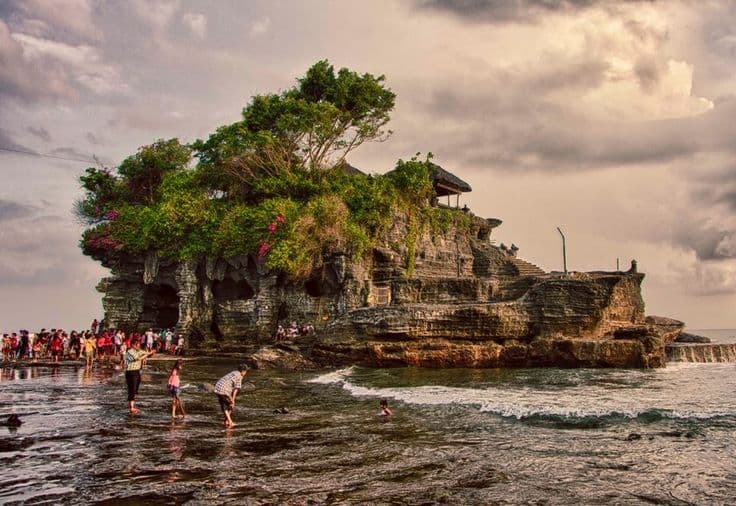
Tanah Lot does not refer to the temple, oddly, it’s the name of the rock formation that the temple sits on.
Pura Tanah Lot is the Balinese name for the temple, and it means “Tanah Lot Temple”.
Tanah Lot, on the other hand, translates into English as “Land [in the] Sea.”
It’s a very popular tourist attraction, and it has become one of the “must photograph” sights on the island of Bali.
The rock that it sits on has been moulded by the tides over hundreds of years, and it’s a compellingly beautiful sight in its own right.
The Founding Of Tanah Lot: Danghyang Niratha
The temple at Tanah Lot is one of the seven sea temples of Bali, and it came into being, they say, in the 16th century thanks to Danghyang Niratha (or Pedanda Shakti Wawu Rauh).
Danghyang was a Hindu holy man who founded the Shaivite Priesthood in Bali.
He wasn’t a native Balinese, however, in fact, he came from Java, and he only came to Bali because he was fleeing the unwanted attentions of the wife of one of his Javanese patrons!
Pumpkin Travel
The legend says that he arrived in Bali having travelled on the top of a pumpkin! They say that this is why some Balinese folks refuse to eat pumpkins to this very day.
Meeting The King
When he arrived, he presented himself in the court of King Dalem. The King wasn’t a very happy man as his kingdom had been suffering from a number of plagues for many years.
On hearing about this, the priest gave the king a lock of his hair and promised it would bring an end to the suffering of his people. The hair still exists in another temple in Bali today.
Arriving In Tanah Lot
Having made peace with the king, Danghyang travelled to the island of Bali, and he came upon the rock on the South Coast and decided to spend a night there because of its beauty.
While he was there, the local fishermen saw him on the land in the sea and decided to bring him gifts for his well-being as they heard the waves crashing around him.
This was well-received, and the priest told the fishermen that the sea god, Dewa Baruna (or Bhatara Segara) of Balinese mythology, was nearby and they needed to build a temple to ensure his happiness.
In order to spread Hinduism further, the locals decided it would be a good idea to worship Danghyang Niratha here too.
Thus, in the 16th century, Tanah Lot saw its first-ever building being constructed Pura Tanah Lot or Tanah Lot Temple.
Tanah Lot’s Place In Bali’s Defense Against The Sea
It has been there ever since, and in the remaining years, there have been seven sea temples constructed around the edge of Bali, and you can see at least one other sea temple and usually two from each of these temples!
Thus, Tanah Lot forms part of a warding circle to prevent the sea gods from lashing out at the land!
The Restoration Of Tanah Lot
In 1980, Pura Tanah Lot was in a very bad state indeed. The rock face of the temple was disintegrating, and the heart of the temple was too dangerous for people to enter.
The Indonesian Government wanted to repair the Pura Tanah Lot, but in the 1980s, Indonesia was not a wealthy country, and such a huge undertaking could not be easily financed by the Indonesian treasury.
So, they turned to the Japanese Government, which generously agreed to provide a loan of 800,000,000 IDR, which was about $480 million USD at that time.
It wasn’t all spent on repairing Tanah Lot Temple, much of the budget was spent on restoring other vulnerable temple locations in Bali, but it was more than enough to stabilize Pura Tanah Lot.
This means that today, about one-third of the rock of Tanah Lot isn’t actual rock – it’s an artificial construct introduced by the Japanese-funded restoration program, which left Tanah Lot Temple in an excellent state of repair for future generations.
2000 World Monuments Watch Report
Tanah Lot Temple was added to the World Monuments Watch (WMF) list in 2000.
They secured some funding thanks to this inclusion from American Express that allowed the local people to do a full conservation study of Tanah Lot and Tanah Lot Temple.
The aim was to create a sustainable future for this tourist attraction that allowed the continued use of the site by worshippers and meant that tourists could visit, too.
They used some additional funding from American Express to build a fence around the temple and a second fence around the entirety of Tanah Lot.
They also redefined all the spatial boundaries on the site to better reflect traditional Balinese standards.
Today, Tanah Lot Temple remains one of the best-maintained and cared-for temple sites in Bali.