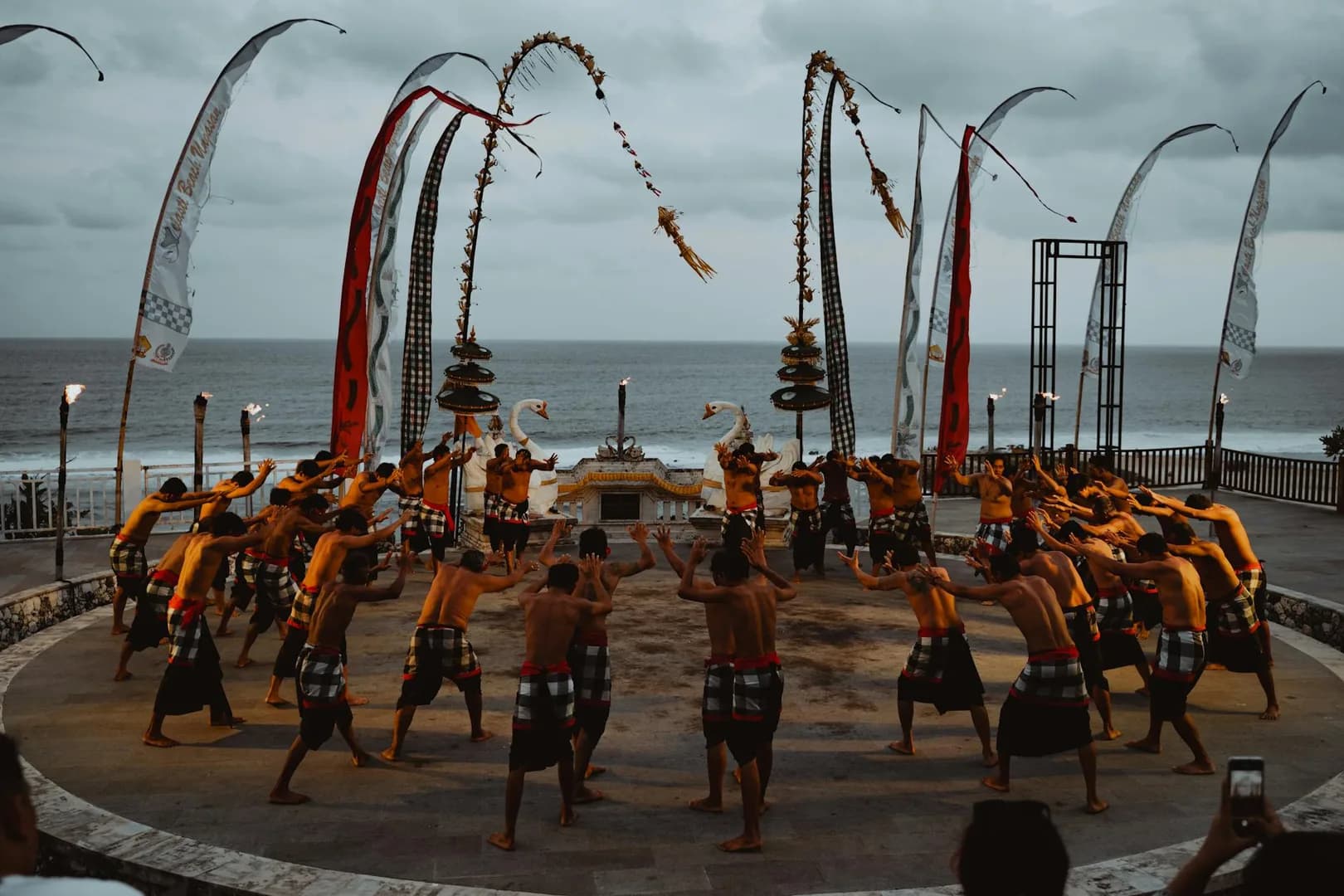
Daily at sunset, Pura Luhur Uluwatu (approx. 6:00–7:00 p.m.)
Kecak Fire Dance
Location
Kuta
Date & Time
Daily at sunset, Pura Luhur Uluwatu (approx. 6:00–7:00 p.m.)
A hypnotic choral ritual staged at Uluwatu Temple each sunset — 70 bare-chested men chant the rhythmic "cak" while enacting scenes from the Ramayana by firelight on the cliff edge above the ocean.
The Kecak (pronounced "ke-chak") is one of Bali's most famous and most visually arresting cultural performances. It was developed in the 1930s by Balinese dancer and composer Wayan Limbak in collaboration with German painter Walter Spies, who adapted the sacred sanghyang trance ritual into a theatrical presentation for wider audiences. Today it is performed nightly at Pura Luhur Uluwatu and several venues in Ubud.
The performance takes place in a circular stone amphitheatre at Uluwatu's clifftop, with the Indian Ocean 100 metres below and the setting sun directly behind the stage. Some 70 bare-chested men sit in concentric rings and produce the performance's entire sonic texture — no instruments — through an interlocking polyrhythmic chant of the syllable "cak" that creates a complex, hypnotic texture resembling a human percussion orchestra. Against this sonic backdrop, costumed dancers enact scenes from the Ramayana: the abduction of Sita, Hanuman's mission to Lanka, and the final battle between Rama's monkey army and the demon king Ravana.
The climax involves live fire: a coconut-husk torch is lit at the centre of the circle, and in the firelight the performers' shadows stretch and writhe across the stone floor in extraordinary patterns. The entire performance runs approximately one hour and reaches its peak exactly at sunset — timing engineered by Spies and Limbak for maximum theatrical effect, and still one of the most reliably beautiful moments in Bali's cultural calendar.