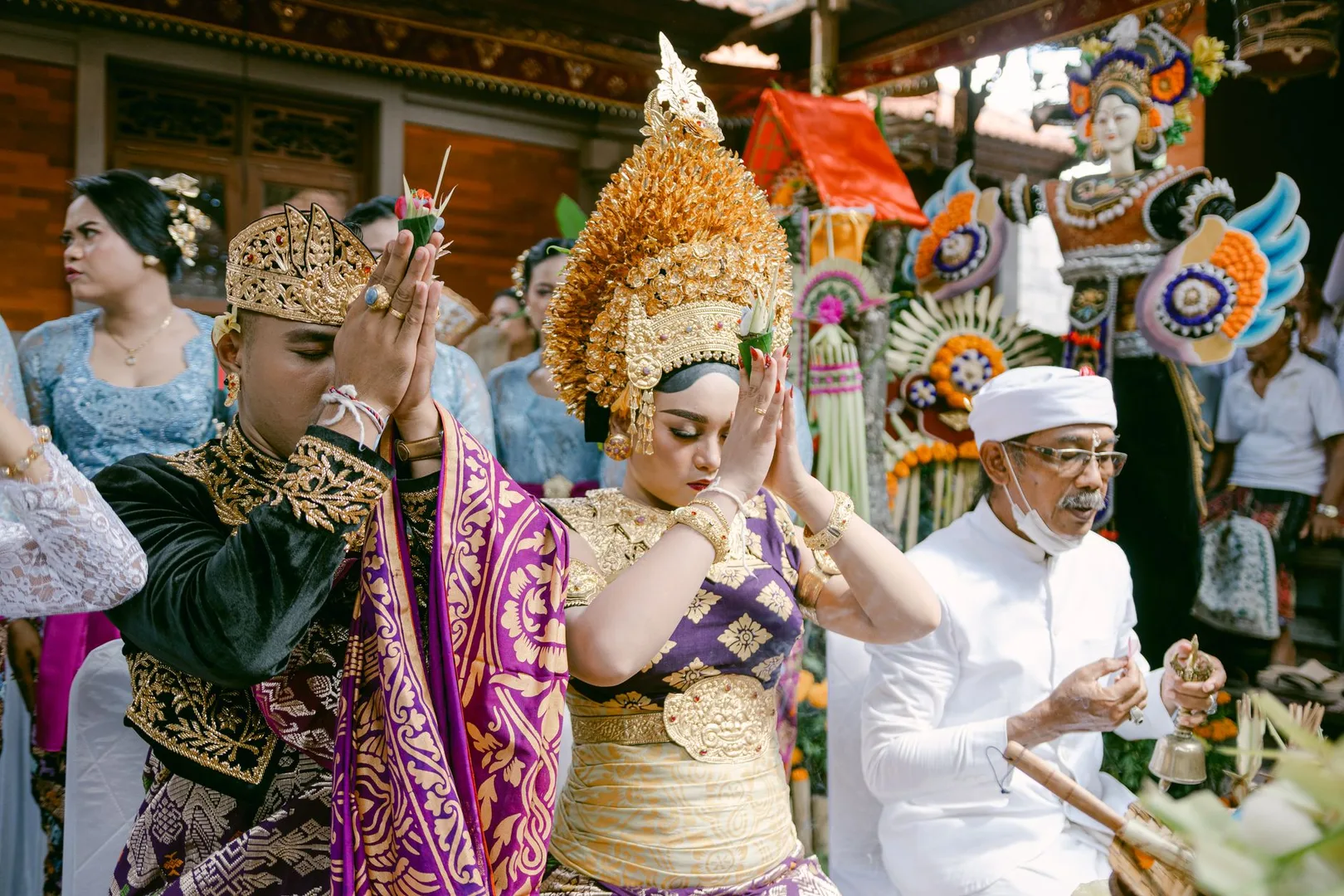
Tenganan Pegringsingan is the most celebrated of Bali's Bali Aga villages — communities whose ancestors predate the 14th-century Majapahit migration that brought Hindu-Balinese culture to the island. Tenganan's community maintains a social structure, land-tenure system, and ceremonial calendar that differs fundamentally from the rest of Bali: the village is collectively owned, outsiders cannot purchase land or permanently reside there, and its 250-odd households follow rules codified in a body of awig-awig (customary law) texts written on lontar palm leaf. The village is most famous internationally for geringsing — a sacred double-ikat textile produced nowhere else in the world. In double-ikat weaving, both the warp threads (vertical) and weft threads (horizontal) are resist-dyed in complex patterns before the cloth is woven, requiring perfect mathematical alignment of two independently dyed thread systems to produce the finished design. A single large geringsing panel can require three to five years from thread preparation to completion. The cloth is considered sacred and is used in healing ceremonies throughout Bali — even in villages where it is not produced — and genuine antique pieces command museum-level prices. Tenganan is also the origin of the makare-kare (pandan war) festival, held annually during Sasih Kalima (roughly June–July), in which young men of the village engage in ritual combat armed with bundles of thorned pandan leaf, accompanied by gamelan selonding music played on ancient iron instruments unique to this village. Visitors are welcome during the festival, which is one of the most extraordinary ritual events in Bali.
Discover Bali
Loading latest insights and destination guides...